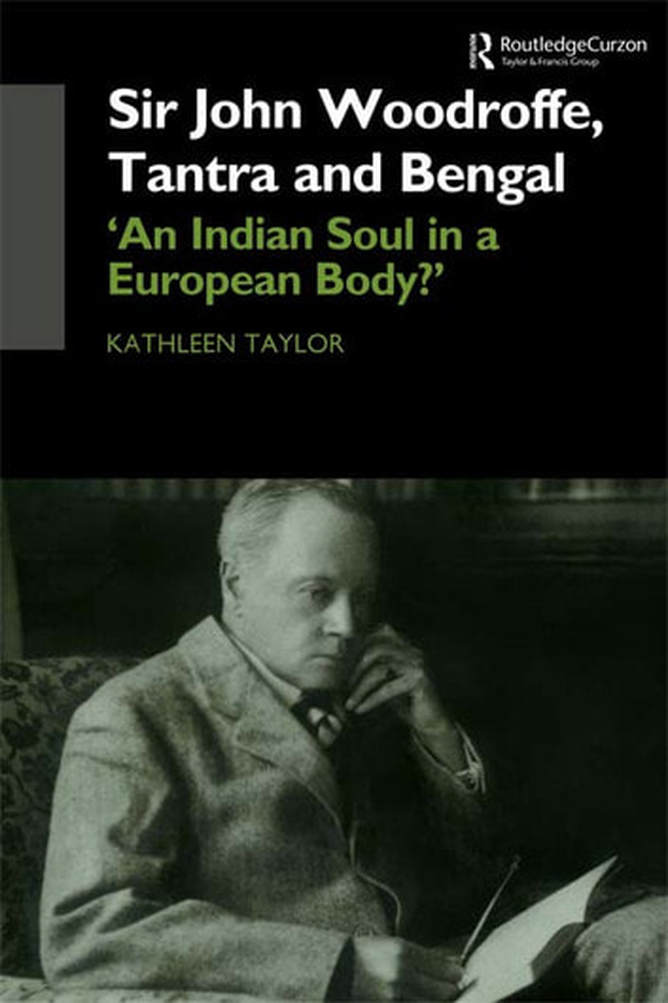
- Sir John Woodroffe aka Arthur Avalon
- Shakti and Shâkta: Essays and Addresses on the Shâkta Tantrashâstra
By Sir John George Woodroffe a.k.a Arthur Avalon
Published by Luzac & Co., London - 1918
Read Book Online:
http://bit.ly/TbgAtX - John George Woodroffe was the eldest son of James Tisdall Woodroffe, Advocate-General of Bengal and sometime Legal Member of the Government of India, J. P., Kt. of St. Gregory, by his wife Florence, daughter of James Hume. He was born on December 15th 1865 and was educated at Woburn Park School and University College, Oxford, where he took second classes in jurisprudence and the B.C.L. (Bachelor of Civil Law) examinations. He was called to the Bar by the Inner Temple in 1889, and in the following year was enrolled as an advocate of the Calcutta High Court. He was soon made a Fellow of the Calcutta University and appointed Tagore Law Professor. He collaborated with the late Mr. Ameer Ali in a widely used textbook Civil Procedure in British India. He was appointed Standing Counsel to the Government of India in 1902 and two years later was raised to the High Court Bench. He served thereon with competence for eighteen years and in 1915 officiated as Chief Justice. After retiring to this country he was for seven years from 1923, Reader in Indian Law to the University of Oxford. He died on 18th January 1936.
A man of studious and retiring habits, he devoted his leisure from judicial duties in the main to Sanskrit and Hindu philosophy and specialized in the Shakti system to an extent not equalled probably by any other British Orientalist. Both in India and in England, he was induced to speak or lecture on the different aspects of Hindu philosophy, but most hearers and readers found and still find it difficult to follow him in the bewildering mazes of the subject. While the shyness of the absorbed student made him slow to reveal his mind to a casual acquaintance or to care for society, he could talk much and well in congenial company. His books are a never exhausting source of information as to the deepest essentials of Indian philosophy.
His greatest contribution, unsurpassed to this day by any scholar, Eastern or Western, lies in the painstaking and thorough exploration of Tantrik literature and the subsequent publication of about 20 Tantrik Texts after careful and critical editing. Further, he has translated a few important Tantrik Texts adding his own valuable commentaries and illuminating introductions. In this category are:
The Serpent Power
The Great Liberation
Principles of Tantra
Kamakalavilasa
Thirdly, as a result of his long and close study of the scriptures and contacts with great Tantrik Pandits of Bengal, he has written books explaining the philosophy underlying the Tantrik Texts. His monumental works of this class are the
Garland of Letters (Varnamala)
The World as Power
Mahamaya (Cit-Shakti or Power as Consciousness)


 RSS Feed